What Does Mobile App Development Cost in India in 2026?
App pricing in India is among the most competitive in the world, which is good news — and also why quotes for the same idea can range from ₹1 lakh to ₹40 lakh. The difference is almost never the screen count. It is the amount of custom engineering behind the screens: the backend, integrations, security and the quality process.
Here are realistic market ranges, consistent with the starting prices we publish:
| App complexity | Typical cost range | Examples |
|---|---|---|
| Simple app | ₹2,00,000 – ₹5,00,000 | Content apps, basic business apps, static catalogs, simple booking |
| Mid-complexity app | ₹5,00,000 – ₹12,00,000 | User accounts, payments, real-time chat, admin dashboards, APIs |
| Complex app / platform | ₹12,00,000 – ₹40,00,000+ | Marketplaces, on-demand platforms, fintech, heavy custom backend |
For international clients, our published starting points are $20,000 for native Android or iOS and $35,000 for cross-platform builds — the same engineering scoped to global rates.
What Drives App Development Costs
- Custom backend and business logic. The single biggest cost driver. A content app with no server is cheap; anything with accounts, payments, or real-time features needs real backend engineering.
- Integrations. Payment gateways, maps, SMS/WhatsApp, ERP/CRM connections, video streaming — each adds development and testing time.
- Design depth. Stock components versus a designed brand experience differ by lakhs. Custom UI matters most in consumer-facing products.
- Security and compliance. Fintech, health and apps handling payments need hardened security, encryption and often compliance work — non-negotiable, and priced accordingly.
- Offline mode, sync and scale. Apps that must work offline, sync across devices, or serve lakhs of concurrent users need architecture planning upfront.
- Team composition. Freelancers build simple apps well; multi-role teams (designer, Android, iOS, backend, QA, PM) are required as scope grows.
Android, iOS or Cross-Platform: The Cost Impact
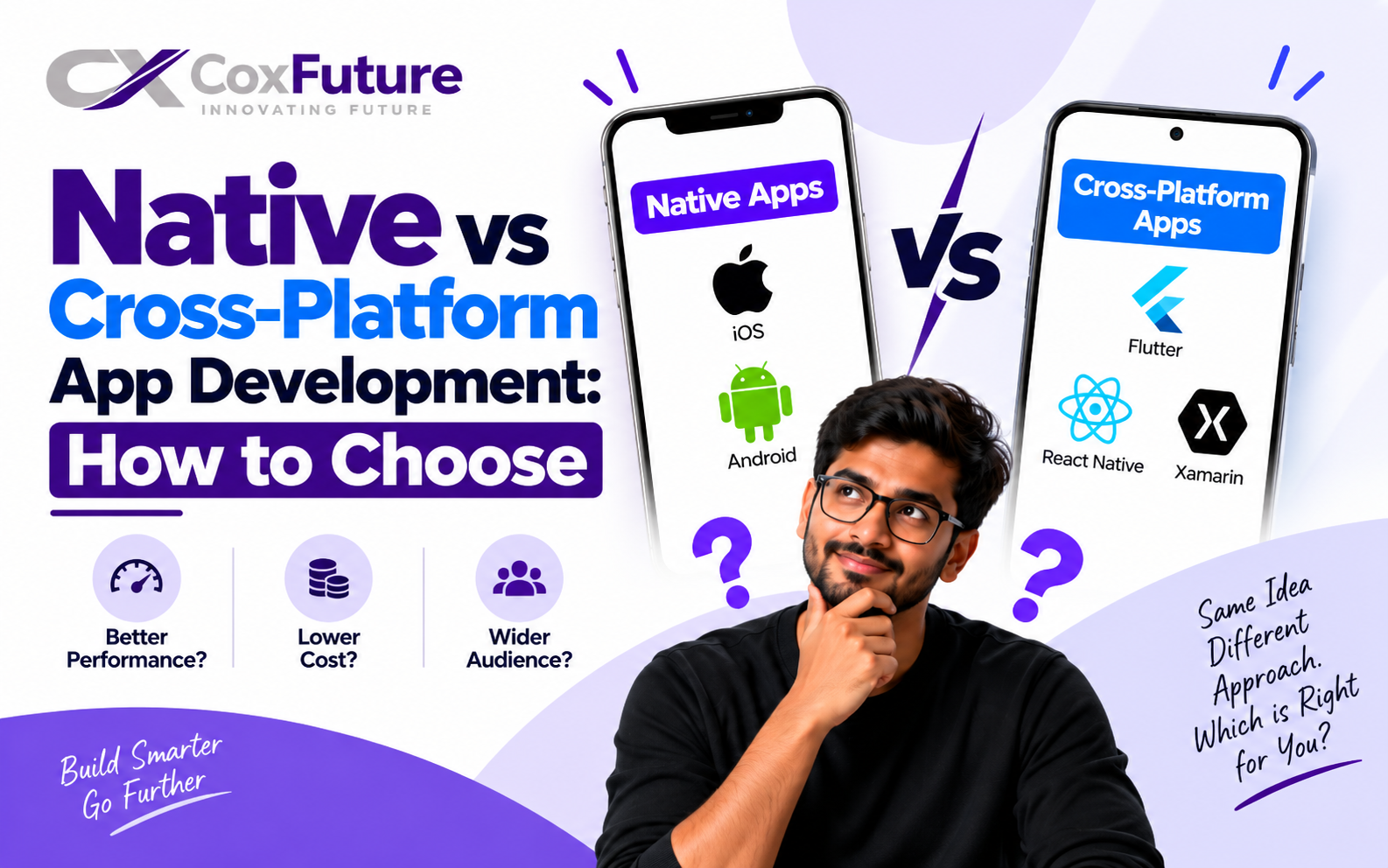
Building natively for both platforms means two frontend codebases — roughly double the frontend effort. Cross-platform frameworks (Flutter, React Native) share one codebase across both, typically landing at 1.2–1.5x the cost of a single platform instead of 2x.
Practical guidance: Android-only makes sense when your audience research shows Android dominance (common in India); iOS-first when targeting premium urban segments abroad. For most businesses needing both, cross-platform delivers the best cost-to-reach ratio. Our detailed comparison of native vs cross-platform development breaks down when each approach wins, and our teams build all three — see Android, iOS and cross-platform development.
Ongoing Costs After Launch
- Servers and infrastructure: ₹5,000–₹1,00,000+/month depending on users and data (₹20,000/month is typical for a growing mid-size app).
- Maintenance: OS updates, library upgrades, bug fixes — plan 15–20% of the build cost per year.
- Store fees: Google Play $25 one-time; Apple App Store $99/year.
- Third-party services: SMS, push notifications, maps, payment processing — per-use charges.
- Growth: ASO, ads, content. An unmarketed app is a diary, not a product.
How to Budget Smartly (And Avoid the Two Classic Mistakes)
Mistake 1: Building everything in v1. Every feature you defer makes v1 cheaper and faster to validate. Launch with the core loop — the one thing users must do — and add features based on real usage. An MVP at ₹3–5 lakh that validates demand beats a ₹15 lakh launch that guesses.
Mistake 2: Choosing the cheapest quote. Apps have long lifecycles; badly structured code becomes more expensive every month you keep it. Evaluate vendors on process (design docs, sprint demos, test coverage, code handover), not just price. Our guide on evaluating a development company covers the questions that expose the difference.
Want a scoped, itemized estimate for your app idea? Talk to our mobile team — we'll tell you what v1 should contain and what it should cost, before you commit to anything.