What Each Approach Actually Means
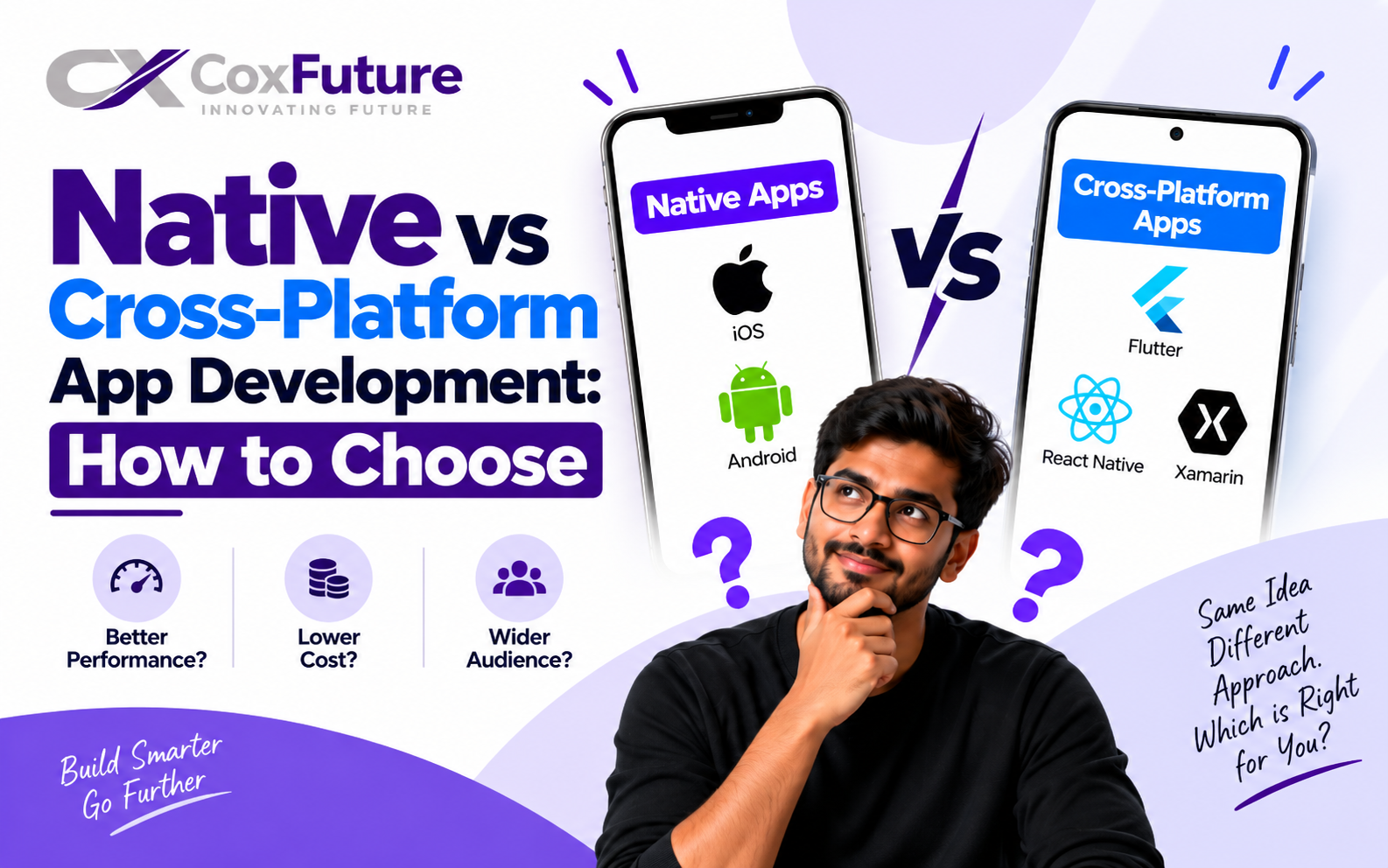
Native development means building separately for each platform: Swift for iOS, Kotlin for Android. The app speaks the platform's own language and gets full, immediate access to every device capability.
Cross-platform development means one codebase (Flutter, React Native) compiled to run on both platforms. You write the app once and deploy everywhere — with occasional platform-specific fine-tuning.
Both produce real, store-quality apps. The difference shows up at the edges: extreme performance demands, deep hardware integration, budget, and how fast you need to move.
Side-by-Side Comparison
| Factor | Native (Swift/Kotlin) | Cross-platform (Flutter/React Native) |
|---|---|---|
| Cost (both platforms) | ~2x single-platform effort | ~1.2–1.5x single-platform effort |
| Performance ceiling | Highest — direct hardware access | Excellent for 90%+ of business apps |
| UI feel | Perfectly platform-native | Near-native; occasional fine-tuning |
| Time to both stores | Longer (two codebases) | Significantly faster |
| Device APIs (camera, BLE, sensors) | Day-one access | Strong via libraries; rare edge cases need native modules |
| Team | Two specialist teams or hybrid devs | One team |
| Long-term maintenance | Two codebases to maintain | One codebase; framework upgrades to track |
The Decision Framework
Go native if: you're building AR/VR, high-end games, real-time video processing, or apps whose brand depends on buttery platform-perfect interaction; your app monetizes premium iOS users primarily; or you have budget for two teams and a long horizon.
Go cross-platform if: you're launching an MVP and need both audiences fast (the usual startup case); your app is forms, feeds, bookings, e-commerce, content or chat — i.e., standard business logic; you have one team and a bounded budget; or you need feature parity across platforms from day one. Most of the apps we build fall here — see our cross-platform development work, alongside our native Android and native iOS services.
Go Android-only or iOS-first if: audience data settles it. In much of India, Android dominates outright — an Android-first native build can be the smartest budget play. For premium urban or international audiences, iOS share often justifies going first there.
The Hybrid Reality Nobody Mentions
The choice isn't permanent. Mature teams frequently start cross-platform, then move specific performance-critical screens or modules to native while keeping the shared codebase. Architecture planned for this escape hatch — clean separation of UI and business logic — keeps every option open. The reverse also happens: long-lived native apps adopt Flutter for new feature surfaces.
What matters at the start is an honest scoping conversation: what does v1 need to prove, for whom, and by when? Budget-wise, our app cost guide shows what each approach typically costs in India. If you want a recommendation grounded in your actual feature list rather than a framework debate, bring us the idea — we build both ways and will say so when native is genuinely the right call.